
Criminal Justice
Launch your future in criminal justice with a dynamic program designed to prepare you for real careers in law enforcement, corrections, and beyond.

At Centralia College, you’ll learn from experienced faculty who combine academic expertise with real-world knowledge—giving you the practical skills and confidence to succeed from day one.
Complete your degree faster. This accelerated program can be finished in as little as 15 months of full-time study. Whether you’re ready to enter the workforce or continue your education, you’ll also have a clear transfer pathway to a four-year college to further your goals.
Degree Options
Associate in Applied Science (AAS) - Criminal Justice
- Best for students seeking immediate employment.
- Focused on practical job skills
Associate of Arts (AA) - Criminal Justice
- Best for students planning to transfer
- Designed for continuation to a bachelor's degree
Already working in Law Enforcement?
The Criminal Justice Crosswalk Program allows working professionals to earn up to 50 credits for prior training.
- Accelerated path to degree completion
- Aligns with Washington State Criminal Justice Training Commission Basic Law Enforcement Academy and the Washington State Patrol Academy training programs
- Ideal for police officers, deputies, and state troopers
Prepare for a range of rewarding careers in criminal justice, including roles as a police officer, corrections officer, investigator, public safety manager, or criminal justice instructor. Graduates benefit from strong advancement opportunities and competitive salaries in Washington State.
These career pathways offer both stability and opportunities for leadership and growth in the field.
Upon successful completion, students will have demonstrated the ability to:
- Discuss and demonstrate basic procedures related to the fields of law enforcement and corrections.
- Utilize knowledge about state and federal laws that impact law enforcement and corrections in decision making.
- Understand and discuss the difference in relationships between law enforcement, the community and other legal entities.
- Understand and describe the relationships that exist between the various law enforcement, corrections, and the courts systems and at the local, state and federal levels of government.
- Discuss ethics as related to law enforcement and corrections.
Emphasis: Criminal Justice
Degree: Associate in Applied Science
Total Units: 90-93
| First Year | |
| Fall Quarter |
|
| Winter Quarter |
|
| Spring Quarter |
|
| Summer Quarter |
|
| Second Year | |
| Fall Quarter |
|
| Winter Quarter |
|
Notes for Students - Recommended Electives
- SPAN& 121 Spanish I - 5 units
- PSYC& 100 General Psychology - 5 units
- SOC& 101 Introduction to Sociology - 5 units
- BTEC 101 Keyboarding for Business - 3 units
- BTEC 221 Business Communications - 5 units
Student learning is central to the college’s mission. All associate of arts, associate of science, and MRP/DTA degrees are designed to provide experiences that lead to the attainment of general education outcomes as embodied in the following student learning competencies:
- Critical Analysis: the student effectively evaluates information and creates solutions through observation, reflection, reasoning, and experience.
- Communication: the student effectively conveys information and ideas by adapting their communication style to different situations and audiences when speaking, writing, and listening to others.
- Global Awareness & Cultural Competency: the student effectively engages with the multi-cultural world by studying the practices and perspectives of varying communities and cultures.
- Information Literacy: the student effectively engages in a reflective process of inquiry to find, evaluate, use, and ethically create content.
Degree: Associate in Arts
Emphasis: Criminal Justice
| First Year | |
| Fall Quarter |
|
| Winter Quarter |
|
| Spring Quarter |
|
| Second Year | |
| Fall Quarter |
|
| Winter Quarter |
|
| Spring Quarter |
|
Note for Students
The Criminal Justice emphasis is flexible and customizable, allowing you to align your coursework with your career goals or prepare for transfer to a four-year institution. An advisor can help you design a personalized plan to ensure you stay on the right path.
 Dr. Tionna Miller
Dr. Tionna Miller received both her bachelor’s degree in Criminal Justice and her master’s in Social Work from the University of Washington-Tacoma Campus. She later received her doctorate degree in Criminology from the University of Arkansas at Little Rock. Her research and expertise are in Corrections, Re-entry, Mass Incarceration, Alternatives to Incarceration, Mental Health for Justice Involved Individuals, Social Work within Policing, and Community Policing.
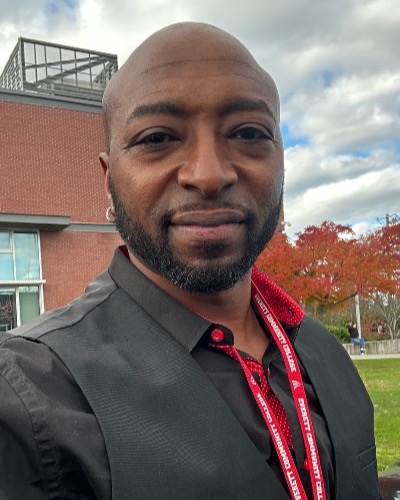 Michael McFadden
Michael McFadden spent 15 years in Law Enforcement as a Patrol Officer, Instructor, K9 Officer, Field Training Officer-Mentor (FTO), and Corrections Officer. He has a teaching/instructor platform in Law Enforcement. He medically retired in October 2018 due to injury. He began pursuing his master’s degree in Criminal Justice in August 2019 and completed that degree in December 2020. He currently teaches Criminal Justice at both Centralia College and Everett Community College. He teaches in online modalities and has been involved in student advising and curriculum development. He teaches various courses, from Criminology to Criminal Law. He was born and raised in South Carolina and served in the U.S Marine Corps and Coast Guard for almost 8 years. He grew up in a culturally and economically challenging area in South Carolina and his background, experiences, education, and training give him a unique perspective.
ContactBusiness, Education, & Human Services ProgramsWalton Science Center Room 118 360-623-8927 cte@centralia.edu |
Dr. Tionna Miller |